'/%3e%3cdefs%3e%3clinearGradient%20id='paint0_linear_6609_68599'%20x1='3.18225'%20y1='15.6908'%20x2='32.433'%20y2='20.6207'%20gradientUnits='userSpaceOnUse'%3e%3cstop%20stop-color='%230048ED'/%3e%3cstop%20offset='1'%20stop-color='%230DECD7'/%3e%3c/linearGradient%3e%3c/defs%3e%3c/svg%3e)
'/%3e%3cdefs%3e%3clinearGradient%20id='paint0_linear_6609_68609'%20x1='3.18219'%20y1='15.6908'%20x2='32.4329'%20y2='20.6207'%20gradientUnits='userSpaceOnUse'%3e%3cstop%20stop-color='%236896FF'/%3e%3cstop%20offset='1'%20stop-color='%230DECD7'/%3e%3c/linearGradient%3e%3c/defs%3e%3c/svg%3e)


From Agent Capability to Everyday Usability: The Design Principles Behind MuseWork
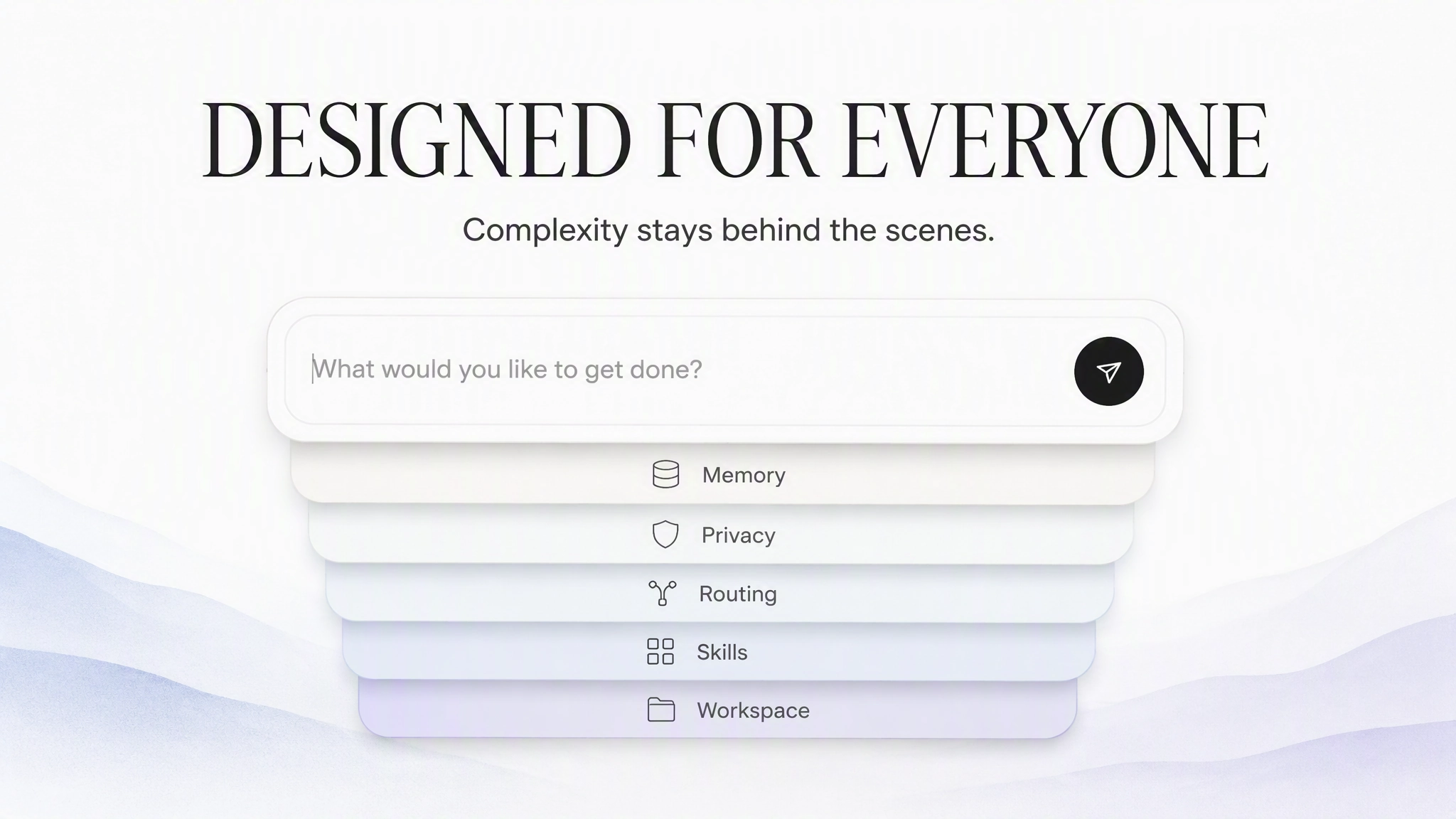
MuseWork's goal is not to showcase how complex Agent technology can be, but to make AI naturally usable for everyone.
Over the past year, products like OpenClaw and Hermes Agent have proven that Agents can write code, operate browsers, call tools, manage files, and accumulate skills and memory through long-term collaboration. These explorations are significant — they've pushed the boundaries of capability forward considerably.
But for everyday users, the first time they open an Agent product, what they see is often not capability but barriers: API keys, model selection, permission configuration, plugin installation, workflows, tokens, VMs.
Users get blocked by AI before they even start using it.
The question MuseWork wants to answer is: can someone who doesn't know how to deploy services, write prompts, understand models, or study Agents still have an AI assistant that's genuinely useful?
We believe the answer is yes. Whether you know how to use AI shouldn't determine whether you can benefit from it.
I. Zero Configuration: Conversation Is the Entry Point
MuseWork doesn't put configuration in front of users. The first time you open MuseWork, you just state what you need.
Behind the scenes, the system handles Agent initialization, workspace allocation, skill loading, long-term memory preparation, and session routing. Users don't need to create an Agent, select a model, install plugins, or understand context windows.
Before users send their first message, they should not be asked to understand any system concepts.
Conversation itself is the entry point. You send a message — that's the start. You keep talking — that's adding context. You switch topics — the system decides whether to open a new context. You return to a previous task — MuseWork picks up the existing context.
Behind this are session parsing and multi-channel orchestration, but that complexity should not be exposed to users. Users shouldn't think "Am I in the right session?" — they should only think "What do I want MuseWork to do?"
II. Natural Interaction: Allow Interruptions, Additions, and Jumps
Real conversations don't follow strict queues. Users might add "include a chart" mid-task, say "stop," or suddenly ask an unrelated question.
MuseWork determines whether a message cancels the current task, supplements the current request, queues a new task, or is independent conversation. State management is a system concern — it shouldn't become a user burden.
Similarly, users shouldn't have to re-explain themselves just because they switched channels. Web, Telegram, WeChat are just different ways of talking — behind them should be the same Agent, the same skills, the same memory.
Channels shouldn't become different "people." MuseWork is still MuseWork.
III. Cost: Let Users Feel Free to Talk More
If users have to calculate cost with every message, AI can hardly become a daily tool. A good assistant should allow users to iterate, revise, and ask casually.
Cost optimization is therefore not just a business concern — it's an experience concern.
MuseWork focuses on three things:
- Cache stable content. System prompts, tool definitions, and skill descriptions are kept in stable order so the model doesn't repeatedly process what it has already read.
- Compress context in layers. Images, tool returns, web content, logs, and long conversations are distilled into what's actually needed for continued collaboration.
- Wake execution environments on demand. Regular conversation stays lightweight; heavier execution environments are only spun up when code needs to run, files need processing, or deliverables need generating.
Don't make users pay for the system's redundant work.
IV. Privacy: You Can't Rely on a Promise Alone
When users hand over files, accounts, calendars, email, and long-term preferences to AI, privacy concerns are legitimate. Truly reliable privacy design doesn't ask users to trust a promise — it makes things that shouldn't be accessed hard to access at the system level.
MuseWork defaults to isolation: each user has an independent workspace; files are stored under the user's own cloud storage path; execution environments only access authorized directories; long-term memory is injected by the server on demand rather than scattered across execution environments.
Third-party authorization tokens are encrypted. Access paths include identity verification, ownership verification, expiration controls, rate limits, and audit logs. Temporary file links require ownership confirmation before issuance and automatically expire.
Privacy protection is not a marketing label — it's the default posture of system design.
V. Memory: A Good Assistant Shouldn't Have to Relearn You Every Time
One of the most exhausting aspects of many AI products is that users have to re-introduce themselves every time: who they are, what they're working on, what format they prefer, where they left off.
MuseWork watches for long-term useful information during conversations: project background, expression preferences, key constraints, milestone plans, user feedback. These aren't simply stuffed into chat history — they're recorded as different types of signals with confidence scores.
Memory isn't just searching chat history either. MuseWork injects stable cognition before a conversation begins, so collaboration doesn't start from zero every time.
An asynchronous memory engine processes recent signals: which are more certain, which are outdated, which need merging, which should be forgotten. Internally, we call this process "Dreamweaving."
Every collaboration should make the next one a little easier.
Conclusion
MuseWork's principles are simple: keep complexity in the system, keep simplicity for the user.
Zero configuration, because setup shouldn't filter out users. Implicit sessions, because users shouldn't manage context. Unified multi-channel, because wherever users speak, they should be talking to the same assistant. Caching, compression, and on-demand execution, so users feel free to talk more. Isolation and encryption, to minimize what users must "take our word for." Memory and Dreamweaving, to make long-term collaboration continuous.
The future of AI should not belong only to those who are best at using AI.
It should also belong to those who simply want to get one thing done well, express one idea clearly, or make one day a little easier. That is the direction of MuseWork.