'/%3e%3cdefs%3e%3clinearGradient%20id='paint0_linear_6609_68599'%20x1='3.18225'%20y1='15.6908'%20x2='32.433'%20y2='20.6207'%20gradientUnits='userSpaceOnUse'%3e%3cstop%20stop-color='%230048ED'/%3e%3cstop%20offset='1'%20stop-color='%230DECD7'/%3e%3c/linearGradient%3e%3c/defs%3e%3c/svg%3e)
'/%3e%3cdefs%3e%3clinearGradient%20id='paint0_linear_6609_68609'%20x1='3.18219'%20y1='15.6908'%20x2='32.4329'%20y2='20.6207'%20gradientUnits='userSpaceOnUse'%3e%3cstop%20stop-color='%236896FF'/%3e%3cstop%20offset='1'%20stop-color='%230DECD7'/%3e%3c/linearGradient%3e%3c/defs%3e%3c/svg%3e)


GPT-6 Astra Released: A Major Upgrade for Complex AI Agent Work
OpenAI released GPT-6 Astra on September 3, 2026. The upgrade is not about making AI capable of work for the first time. Its focus is improving computer use, tool calling, software engineering, and reliable execution across longer, more complex tasks.
MuseWork now uses GPT-6 Astra as the primary foundation model for its Agent. You can assign research, data analysis, presentation, website, or coding work without configuring an API, model, or runtime environment.
GPT-6 Astra at a glance
- What is it? OpenAI’s new frontier model for computer use, tool calling, professional knowledge work, and long-running tasks.
- When was it released? September 3, 2026 in the United States.
- What improved? Understanding complex goals, maintaining multi-step workflows, using tools, and producing reviewable results.
- How can you use it? Through OpenAI’s announced channels as availability expands, or directly in MuseWork for real work.
- What changes in MuseWork? GPT-6 Astra is the Agent’s primary foundation model, working with context management, tool orchestration, permissions, and result verification.
What is GPT-6 Astra?
GPT-6 Astra is OpenAI’s new model for complex, tool-enabled work. Official materials emphasize computer use, browsing, software engineering, professional knowledge work, and multi-step processes rather than conversation alone.
Earlier models could already complete work. The more accurate change is that Astra further improves an AI Agent’s ability to hold onto a goal, use tools correctly, respond to feedback, and deliver results over a longer execution.
Artificial Analysis reported clear gains over the previous generation in long-horizon knowledge work and automation evaluations, while noting that some professional-task and presentation-quality measures did not improve at the same rate. Its value should therefore be judged through the quality of completed tasks, not a blanket claim that it is simply “smarter.”
When was GPT-6 Astra released?
OpenAI lists September 3, 2026 as the release date. Access began with a limited set of organizations and is expanding through paid ChatGPT plans, the OpenAI API, Microsoft Azure, and AWS.
Availability can differ by product, region, and account. Developers should check the latest official console information. People who want to complete work directly can use GPT-6 Astra through MuseWork’s Agent workflow.
What are GPT-6 Astra’s core capabilities?
1. Understanding complex requirements
A capable Agent must identify the goal, source scope, constraints, and definition of done from natural language. Better understanding reduces early-stage drift.
2. Maintaining long-running workflows
Complex work crosses research, analysis, production, verification, and revision. Astra is designed to preserve the main objective across those steps and continue when requirements change.
3. Computer use and tool calling
An Agent may need browsers, code environments, file systems, and specialist tools. Stronger tool use helps research, data processing, web production, and code changes operate as one workflow.
4. Delivering professional outputs
Completion usually means an editable, inspectable report, document, spreadsheet, presentation, website, or code change—not only advice or a draft.
5. Working across files and sources
Within authorized boundaries, an Agent must combine multiple files, identify related evidence, resolve conflicts, and organize findings around one objective.
How do you use GPT-6 Astra?
Developers can follow availability in the OpenAI API, paid ChatGPT plans, Microsoft Azure, and AWS. Direct model use normally requires API configuration, runtime tools, and safety controls.
To use GPT-6 for finished work in MuseWork:
- Describe the goal, audience, and desired outcome.
- Provide the necessary material through files, webpages, or authorized local tools.
- Set boundaries for reading, editing, and actions that require approval.
- Define completion, such as a sourced report, editable deck, tested code, or working page.
- Review and revise while the Agent continues from the same context.
You can start with MuseWork Deep Research, then turn verified findings into an editable deck with AI Slides or the research-to-presentation workflow.
GPT-6 Astra vs GPT-5.6 Sol
Both generations can understand, generate, call tools, and support Agent execution. Astra’s incremental gains center on long-running tasks, computer use, software engineering, and complex tool coordination. It did not make work execution possible for the first time.
Public evaluations show meaningful gains in some long-horizon knowledge and automation tasks, not universal leadership on every measure. Test the model against your own requirements for quality, speed, cost, and safety.
How GPT-6 Astra improves MuseWork
Building on existing Agent execution, MuseWork now uses GPT-6 Astra as its primary foundation model to strengthen the understanding, execution, and delivery of long-running, multi-tool work.
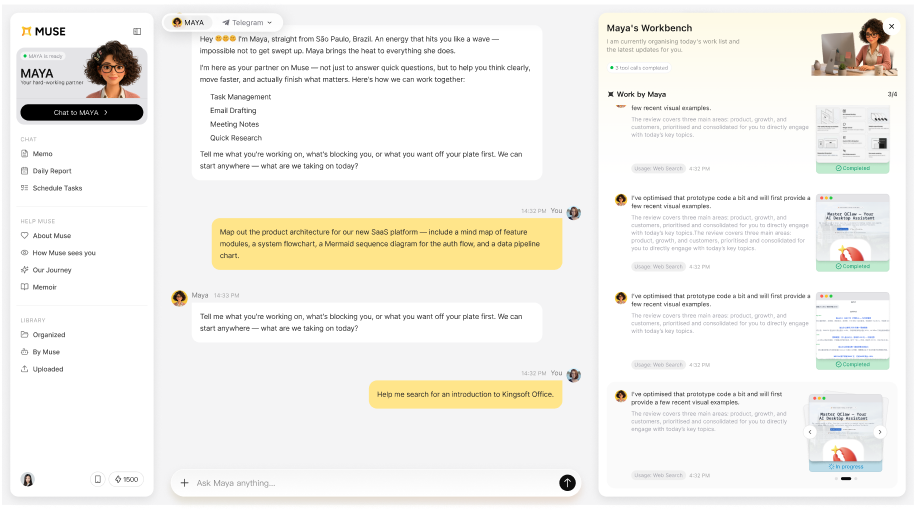
For deep research, the Agent can keep searching, filtering, and cross-checking sources around one question. For spreadsheets and presentations, findings, data, and formatting requirements can stay connected. For development, it can inspect a project, implement changes, run tests, and report evidence. MuseWork Desktop can also use authorized local files and tools.
Why the model alone is not enough
ARC Prize reported a score of 62.7% for GPT-6 Astra in its standard environment and 99.9% with a Provider Adapter that preserves reasoning state and compresses long conversations. ARC Prize described both as leading results while emphasizing that reaching the benchmark ceiling does not prove artificial general intelligence.
The gap illustrates a practical point: the model shapes the capability ceiling, while the surrounding system determines whether that capability becomes a dependable result. MuseWork manages context, task decomposition, tools, permissions, recovery, and verification around Astra.
Safety, permissions, and verification
OpenAI classifies GPT-6 Astra as its first model to reach the company’s “Critical” cybersecurity capability threshold. Its system card reports stronger compliance with safety constraints than GPT-5.6 Sol, but also describes monitoring challenges under some adversarial conditions.
That does not mean ordinary use is inherently dangerous. It means that more capable computer use and longer autonomy make product-level controls more important: narrow authorization, protection of sensitive data, confirmation for irreversible actions, activity records, and independent verification.
From capable execution to more reliable completion
GPT-6 Astra pushes frontier-model competition further toward the quality of completed complex tasks. The model must not only understand and generate; it must preserve the objective, use tools correctly, respond to feedback, and leave a result that can be inspected and reused.
The real measure of the upgrade is whether a task reaches completion with fewer interruptions, clearer control, and a useful deliverable.
Use GPT-6 Astra in MuseWork now
GPT-6 Astra is now the primary foundation model in MuseWork’s Agent workflow. You do not need to request separate API access or configure a tool environment.
Start with one real assignment: request a verified research report, analyze business data and build a presentation, or provide a code project and acceptance criteria for implementation and testing.
Sources
- OpenAI, GPT-6 Astra: A New Generation of Intelligence, September 3, 2026.
- OpenAI, GPT-6 Astra System Card, published September 3 and updated September 9, 2026.
- ARC Prize, OpenAI’s GPT-6 Astra on ARC-AGI-3, September 2026.
- Artificial Analysis, Benchmarking GPT-6 Astra, September 9, 2026.
- CNBC, OpenAI announces rollout of GPT-6 Astra model, September 3, 2026.
Information checked September 23, 2026. MuseWork model integration is product information. Third-party benchmarks and safety findings reflect their publishers’ test conditions and do not guarantee results for every task.
FAQ
What is GPT-6 Astra?
GPT-6 Astra is OpenAI’s September 2026 frontier model focused on computer use, tool calling, software engineering, and long-running complex tasks.
When was GPT-6 Astra released?
OpenAI released GPT-6 Astra on September 3, 2026. Availability can vary by product, region, and account.
How can I use GPT-6 Astra?
Developers can follow OpenAI API, paid ChatGPT, and cloud-platform availability. Users can also access it as MuseWork’s primary Agent model without configuring an API or runtime.
How is GPT-6 Astra different from GPT-5.6 Sol?
Both support Agent execution. Astra’s main gains are in long-running tasks, computer use, software engineering, and complex tool coordination; results still depend on the task and system.
Does MuseWork use GPT-6 Astra?
Yes. GPT-6 Astra is the primary foundation model for the MuseWork Agent, strengthening complex-task understanding, multi-step execution, tool coordination, and professional delivery.